Research
What we work on
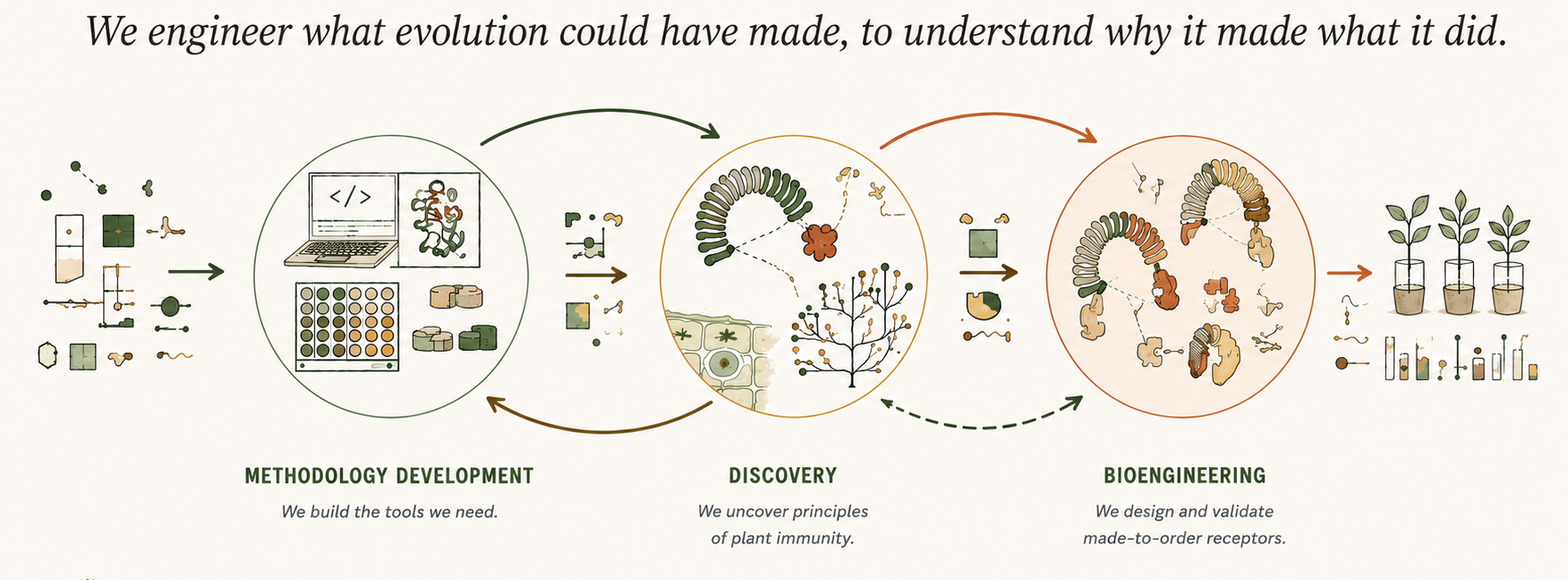
We engineer what evolution could have made, to understand why it made what it did.
The Kourelis Lab builds and dissects plant immune receptors using synthetic biology approaches. The lab combines structure-informed protein engineering, high-throughput screens, and computational biology to produce receptors that recognise pathogen molecules they have not seen before, and uses the failures and successes of those designs to read back what natural selection was optimising.
What we do
From understanding to engineering: synthetic biology approaches to build made-to-order plant immunity.
Made-to-order receptors are the working endpoint. The intermediate steps are the science: which receptor scaffolds tolerate which kinds of perturbation, how recognition surfaces map to effector chemistry, how receptor networks integrate signals from helpers and sensors, and how all of this constrains what a designable immune receptor looks like.
Why plant immunity
Plant immunity sits in an unusual position. It is academically rich, it is experimentally tractable, and the principles it reveals translate.
Academic richness. Pathogen recognition is the first step in any immune response, so the proteins that perform it are the proteins evolution rewrites most often. NLR (nucleotide-binding leucine-rich repeat) immune receptors are arguably the fastest-evolving and most diverse gene family in plant populations; the pathogen effectors they recognise evolve under matching pressure. Standard evolutionary models break on these genes. Phylogenetic methods that assume slow, near-neutral change cannot recover the history of a family that gains and loses recognition specificities on a generation-by-generation timescale. The same property makes these receptors useful for engineering. Evolution has optimised them for evolvability rather than for any one function, which leaves their sequence space tolerant of radical edits and full of viable starting points.
Experimental tractability. Immune recognition sits at the edge of plant signalling networks rather than at their centre. We can perturb a receptor and read out the response without the pleiotropy that complicates work on receptors involved in development. Genetic, biochemical, and imaging tools for Nicotiana benthamiana and Arabidopsis thaliana are mature; high-throughput approaches let us screen receptor variants at scale.
Generalisability. Downstream immune responses are conserved across land plants and are agnostic to pathogen identity. A mechanism worked out in one host typically holds in another, and fundamental discoveries translate to application without long detours.